Regulated Industry · Healthcare · HIPAA
Offline Health AI
The average healthcare data breach now costs $10.9 million. OCR enforcement actions are increasing. Most BAAs do not protect PHI when the vendor is breached — they transfer liability, not risk.
Offline Health makes the BAA question moot. There is nothing to breach on our end because we never receive your PHI. Clinical AI deployed on your hardware, inside your network.
OCR has levied enforcement actions against healthcare organizations whose cloud AI vendors were breached, finding that the BAA did not relieve covered entities of their HIPAA obligations. The only structural protection is keeping PHI within your environment.
HHS Office for Civil Rights · Active enforcement posture
The Regulatory Environment
$10.9M
Average healthcare breach cost
IBM Cost of a Data Breach Report 2023. Healthcare has the highest average breach cost of any industry for the 13th consecutive year. Cloud AI tools expand the attack surface significantly.
IBM Security · 2023
BAA Limitation
Business Associate Agreements do not prevent breaches
BAAs transfer contractual liability but do not prevent the vendor from being breached. When a cloud AI vendor is compromised, your patients' PHI is compromised. The BAA determines who pays — not whether it happens.
OCR Enforcement Guidance
Structural Protection
No BAA required. No vendor to breach.
Offline Health processes PHI exclusively on your hardware. We never receive, store, or transmit patient data. There is no vendor relationship to breach. HIPAA compliance is structural, not contractual.
Offline Intelligence Architecture
HIPAA compliant by architecture
sent to the cloud
sealed within your infrastructure
queries, no usage metering
The Case for Going Offline
Real objections.
Resolved by architecture.
What hospitals tell us
How we respond
HIPAA Compliance
"Our BAA with the cloud AI vendor expires next quarter and compliance is questioning it."
No BAA required. No vendor. Compliance is structural, not contractual.
Data Residency
"Patient data cannot leave the hospital network per our security policy."
Air-gap capable. Runs on hospital hardware. Zero network calls.
Security Governance
"We need AI for clinical notes but our CISO says no to every vendor."
Open-source runtime. Auditable. No vendor relationship to approve.
Cost Structure
"We pay per-seat for AI tools and utilization is only 20% — we're paying for nothing."
Perpetual license. Unlimited users. Unlimited queries. One flat cost.
Product — v0.1.1
License
Perpetual Runtime
Optional Annual
Support & Model Refreshes
Memory Index
Your clinical knowledge base compounds every day
Every patient session, records, and reports add up to a permanent, queryable knowledge asset.
Memory Index
Your Facility's Accumulated Clinical Knowledge
1,247
Clinical facts accumulated
89
Patient sessions processed
342
Records analyzed
0
Bytes transmitted externally
This system has accumulated 1,247 clinical facts across 89 patient records & 342 sessions
Pre-Seeded Clinical Knowledge Vaults
Curated clinical knowledge bases that ship on a drive and load directly into your local database. Start with domain-specific expertise already populated.
Offline Health eliminates compliance risk through smart design and architecture. No connection means no exposure, ever.
HIPAA Compliant by Architecture
Patient data never leaves your environment. Zero external transmission — not by policy, by design. Compliance is structural, not contractual.
On-device inference · Zero API calls · No BAA required · Air-gap capable
Clinical Memory
The AI learns from every patient interaction, building longitudinal context that compounds over time — entirely within your infrastructure.
Persistent session history · Patient context threads · Cross-session recall · Local SQLite
Medical Document Intelligence
RAG-powered analysis of clinical notes, lab reports, discharge summaries, and medical records. Full offline inference on your hardware.
PDF · DOCX · HL7 · Clinical notes · Lab reports · process up to 16 files per query
Diagnosis & Treatment Support
Private AI chat with clinical-aware reasoning. Ask about differential diagnoses, drug interactions, and treatment protocols without any data leaving your network.
Clinical Q&A · Drug interactions · Protocol review · Differential diagnosis
Regulatory Compliance Tracking
Automated tracking of regulatory changes across healthcare jurisdictions. Stay current with CMS, FDA, and state-level requirements entirely offline.
CMS · FDA · State regulations · HIPAA updates · SOC 2
Export & Reporting
Turn any clinical session into a structured report. Export summaries, findings, and recommendations as Word, PDF, or plain text for the patient record.
.docx · .pdf · .txt · Structured clinical notes
Clinical Workflow
Patient record review in under seconds.
Open a patient session
Launch Offline Health → New Session → "Patient ID: 00412 · Cardiology Review" · Encounter type: Follow-up.
Attach clinical documents
Drop in the discharge summary, recent labs, and imaging notes via the file panel. All text is indexed locally.
Run Clinical Analysis
Select Deep Analysis and send. The AI returns diagnoses, medications, lab anomalies, and risk flags by document section.
Ask follow-up questions
Switch to Clinical Chat: "What are contraindications for the current medication list given the renal function?" Fully offline.
Generate and export
Open the Notes panel, draft the clinical summary using the analysis. Export as .docx or .pdf for the patient record.
Hospitals & Health Systems
Clinical Research Teams
Private Practices
Telehealth Providers
Medical Billing & Coding
Healthcare Compliance Teams
You choose the model.
It runs on your hardware.
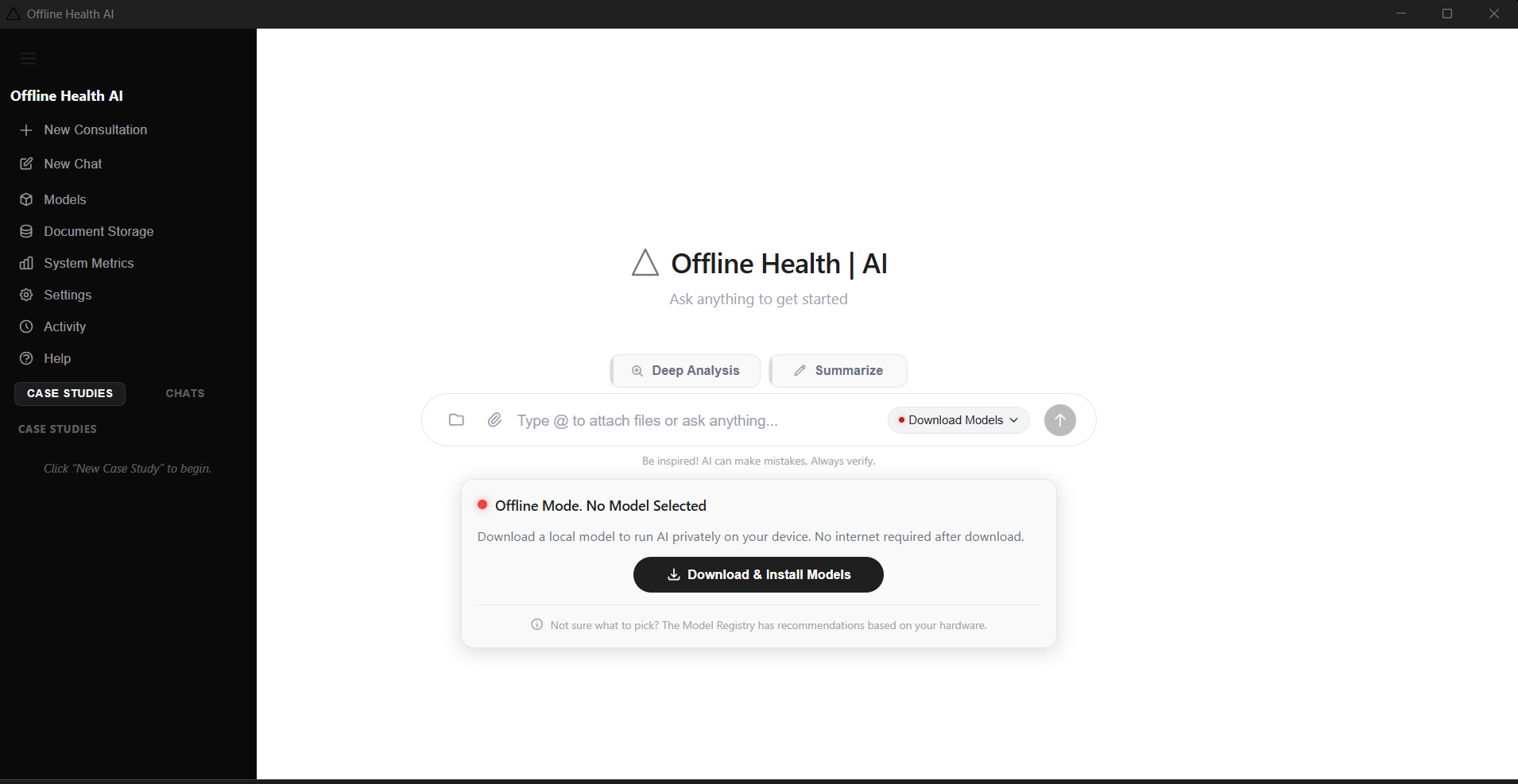
Browse and download open-source AI models directly inside the app. Switch models mid-session to match the clinical task. A faster model for quick notes, a larger one for deep differential analysis. Once downloaded, no internet required.
Private healthcare intelligence.
Deployed in your environment.
We deploy Offline Health on your servers. PHI stays inside your network. No BAA negotiation. No vendor breach risk. Start with a 30-day proof of concept in one department.