Introducing Offline Counsel AI
Frequently Asked Questions
We believe AI sovereignty is a fundamental right. The legal profession has been slowed down in the current AI revolution because every major AI system was built on the same flaw that the data must leave premises and infrastructure to be processed. For law firms and legal departments, that is not an inconvenience. It is a privilege problem.
We build the infrastructure layer that brings enterprise-grade AI permanently inside your environment, so that powerful AI and complete privacy are never a tradeoff again.
Legal practice operates under obligations that no other profession carries in quite the same way. Attorney-client privilege, professional conduct rules such as ABA Model Rule 1.6, client confidentiality agreements, and cross-border data protection law all constrain where a document is allowed to be processed.
Sending a privileged document to a third party service is not a procurement question. It is a question of whether privilege survives the transmission. Our architecture removes the question entirely because nothing leaves the firm.
Privileged material, whether it is a client file, a contract under negotiation, or work product prepared in anticipation of litigation, cannot be exposed to systems or vendors outside a firm's direct control without creating legal and professional risk. This is precisely the constraint our architecture is built to solve.
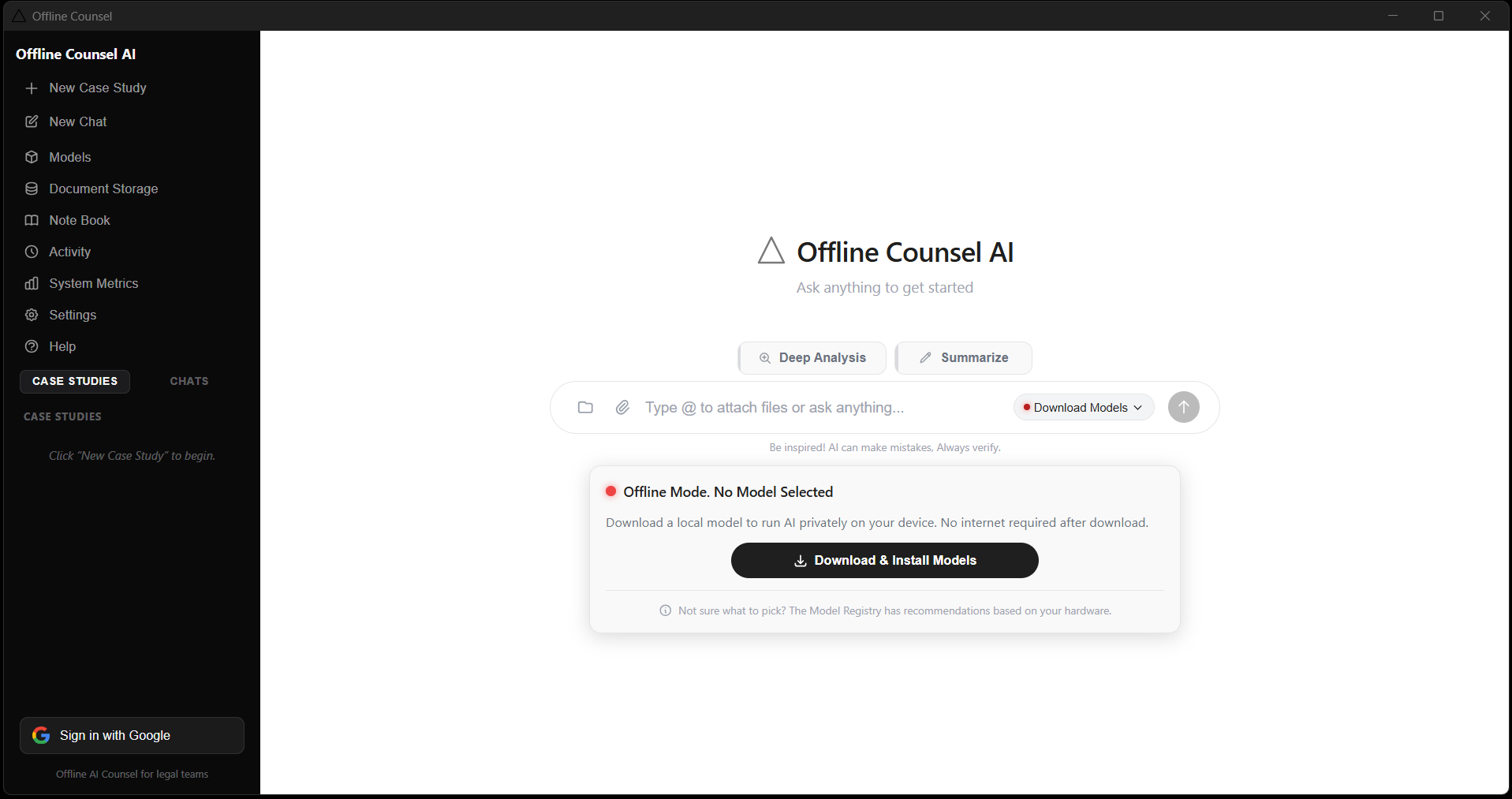
Offline Counsel AI serves legal teams and law firms. It runs entirely on the customer's own hardware, processes no data externally, and accumulates institutional knowledge across matters without a single byte ever leaving the environment. It is ready for production deployments.
The foundation of the product is our Rust-based inference runtime: stateful, hardware-agnostic, and built from the ground up for air-gapped and disconnected environments. It supports x86, ARM64, and Apple Silicon without any configuration changes.
We are opening paid pilots with law firms and in-house legal departments now. That is the current focus, and the only one.
Free and open source developer tools: our Chat Interface, CLI, CLAW agent, and SDKs are free forever. They build community, drive adoption, and establish Offline Intelligence as the default infrastructure for private AI development. This is our distribution engine, not a cost center.
Perpetual license for legal: Offline Counsel is sold as a perpetual license. Your runtime never expires, and there are no usage fees or per-seat charges. Optional annual support plans provide model refreshes, compliance documentation updates, and priority access to new capabilities. This structure gives firms the predictability of a one-time purchase and gives us recurring revenue from the organizations that depend on staying current.
Private deployment for firms with specific security requirements: we install and configure the runtime on your own servers, tuned to your infrastructure, your retention policy, and your audit standards.
We are building toward a fundamentally different AI architecture for the world, one that is distributed, sovereign, and efficient rather than centralized, dependent, and energy-intensive.
At scale, this means every law firm, legal department, and chambers operates with full AI capability, independently, privately, and without depending on infrastructure they do not own or control.
We offer a complete stack across three layers, designed to meet you wherever you are in your AI journey.
For end users and enterprises, we offer ready-to-use applications that bring private AI into your workflows immediately.
For developers and engineering teams, we offer native SDKs and bindings across all major programming languages, so any team can embed our inference and memory management capabilities directly into their own systems and applications.
For enterprises with specific compliance or deployment requirements, we offer private deployment solutions configured for your infrastructure, your regulatory environment, and your security standards.
Privacy in our system is not a policy or a setting. It is an architectural property upon which everything is built. Overriding by a vendor, or compromised by a breach is practically impossible.
For legal practice, our architecture is designed to support ABA Rule 1.6, GDPR, CCPA, and SOC 2 requirements. You own the hardware. You own the model. You own the data. We provide the infrastructure layer that makes it all work together.
The difference is architectural.
Cloud AI services process your data on infrastructure owned and operated by a third party. Your queries, your documents, your context, and your outputs all travel across networks you do not control and are processed in environments you cannot audit. For consumer applications, this is an acceptable tradeoff. For regulated industries, it is often a legal disqualifier.
Any legal team where client data leaving the building is not an option.
That includes full service and boutique law firms, in-house legal departments, litigation and eDiscovery teams, corporate transactional groups, compliance functions, and solo practitioners handling confidential matters. If your work is covered by privilege or a confidentiality undertaking, the architecture is built for you.
Compliance in regulated industries is not achieved by adding privacy features to a cloud system. It requires a fundamentally different architecture, one designed to support compliance from the ground up.
Our infrastructure is designed so that all data processing occurs within your certified environment. We do not claim certifications we have not earned. Our architecture is designed from the ground up to support the path to certification in each of these frameworks. We work with enterprise customers to document their deployment architecture for compliance review, and our technical specifications are available for security audit on request.